
Hedge Fund Diligence Framework
Why I Advocate for a Structured DD Framework and a Scoring System

In the previous two articles (here and here), we discussed the purpose of a hedge fund portfolio and a few key criteria for portfolio construction. In this article, we'll introduce a structured fund due diligence framework in the form of a scoring system, and begin to use this framework to examine a real-world fund.
Why I Advocate for a Structured DD Framework
The biggest challenge—and perhaps the primary source of alpha—for a hedge fund allocator is navigating the opacity created by information inefficiency. Unlike public equities where information rapidly disseminates through various accessible channels, the hedge fund landscape remains largely reliant on word-of-mouth exchanges. This inherently limits transparency, making access to high-quality information a crucial differentiator between outstanding allocators and their peers.
The allocator's goal should always be to gather critical information that contributes to formulating a falsifiable hypothesis explaining why a particular hedge fund can consistently achieve a high Sharpe ratio1. To achieve this effectively during fast paced meetings, the allocator must prepare using a structured framework. This preparation enables the allocator to strategically guide conversations, asking targeted questions that fill information gaps without losing sight of the big picture. This is akin to searching for specific puzzle pieces amidst a constant flow of similar-looking pieces moving along a conveyor belt. Success hinges on preparedness and purposefulness.
In addition, a structured DD framework can function as a checklist to avoid missing critical steps in a long and complex process, and act as a repository for lessons learned. Over time, new insights from each diligence effort can be used to improve the framework continuously, like adding new tools to or replacing outdated tools from a growing toolbox2.

Why I Recommend a Scoring System in Particular
A structured DD framework doesn't necessarily need to take the form of a scoring system. In fact, I operated without one for the first three years as an allocator. The reason I recommend it now relates to the fundamental nature of how we learn.
The remarkably rapid ascent of Homo Sapiens, compared to other organisms throughout Earth's extensive evolutionary timeline, largely hinges on our immense capacity to observe, experiment, learn from feedback, and continuously refine our methods. A valuable conceptual framework for understanding this adaptive cycle is the OODA (Observe, Orient, Decide, Act) loop, initially developed by fighter pilots. The survival of individuals, groups, or systems often depends significantly on the speed with which they iterate through this loop.
A critical component that enables a closed OODA loop is the ability to make an explicit, quantifiable prediction, and then observe how reality compares to that prediction. Consider how fighter pilots aim at fast-moving enemy aircraft: even with modern computers, there is no perfect prediction for where the enemy plane will be. Instead, the computer provides an estimated target point, and colored bullet traces allow the pilot to constantly observe the deviation between predicted and actual outcomes and adjust his aim accordingly. This calibration loop, driven by visible feedback and quantifiable estimates, is what enables rapid adaptation in a dynamic environment.
In hedge fund investing, a scoring system functions similarly. By assigning a forward-looking score to each fund during diligence, the allocator creates a prediction that can later be tested against actual investment outcomes. This comparison enables allocators to measure the predictive power of their judgments, identify where and why certain assessments fell short, and refine the diligence framework over time.
Scoring System Overview
With the rationale established, we now turn to how the scoring system works.
There are seven categories of assessment, representing the key pillars of an investment thesis. Each category is scored on a scale from 0 to 5 and weighted according to its strategic importance. The framework is as follows:
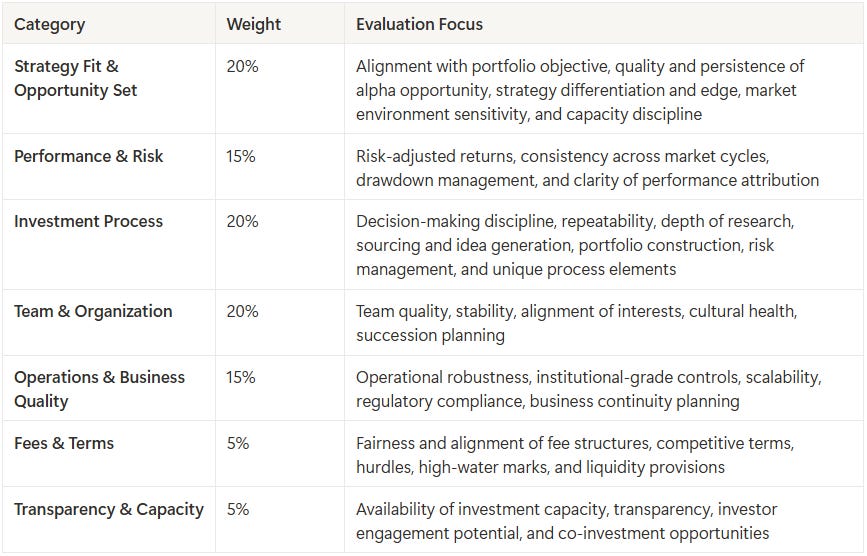
To demonstrate this framework in practice, in the next post we'll apply it to an actual investable fund.
The scientific method of falsification was introduced by philosopher Karl Popper as a more rigorous alternative to induction. While induction attempts to generalize from past patterns, often assuming the future will resemble the past, falsification focuses on constructing hypotheses that can be tested and potentially disproven. This method encourages more robust forecasting by forcing the investor to consider what would falsify their thesis, promoting adaptive thinking and continuous refinement in the face of uncertainty during market turmoil.
For readers interested in learning more about the merits of using checklists, I recommend the book The Checklist Manifesto.