
Is There Room Left for Small Allocators in the Alpha Food Chain?
How agility and off-benchmark thinking can unlock niche alpha in a world dominated by giants.

As a hedge fund allocator at a single family office, I manage a portfolio that is dwarfed by giants in the allocator space—from endowments and foundations to Funds of Funds. The biggest challenge for small-scale allocators like myself is the disadvantageous terms we face when trying to access consensus top managers. This piece explores how small allocators can adapt and compete in a landscape increasingly dominated by giants.
In this article, I will first provide an overview of the alpha food chain, from sources of alpha (prey) to various hedge fund strategies (predators) and to how captured alpha is distributed. Then I will explore the structural disadvantages that small-scale allocators face. Finally, I will explain how “Guerrilla Warfare” strategy can help small-scale allocators carve out a niche to survive and thrive.
The Alpha Food Chain
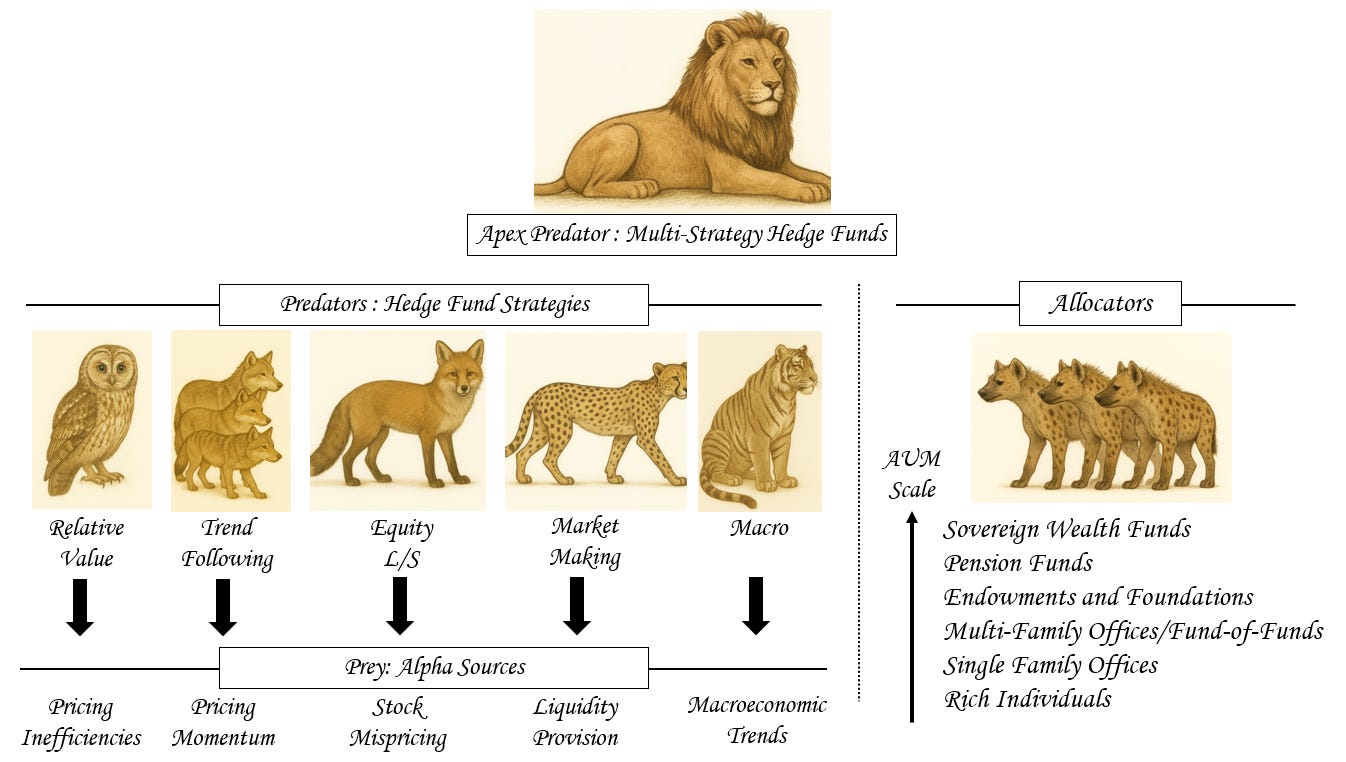
The alpha food chain in the hedge fund space closely resembles a natural wilderness ecosystem, as illustrated above.
On the left, at the bottom of the food chain, lie the "prey"—alpha sources representing inherent market patterns that provide a sustainable supply of alpha opportunities. The "predators" are various hedge fund strategies that hunt these alpha sources.
On the right, allocators maintain a complex relationship with the predators, often backing them with capital in exchange for a share of the "catch", while sometimes competing directly by running in-house operations such as stock selection teams.
On top of them all, Multi-Strats have achieved the apex predators status, becoming part allocator, part hedge fund. I will explore these players in detail below.
Prey and Predator
In modern markets, alpha can be generated from several broad opportunity sets:
Pricing Inefficiencies
This exists due to market segmentation, information asymmetry, differences in asset liquidity, structural complexities, or other technical factors.
Predator: Relative Value strategies betting on convergence of price disparities between related financial instruments. This includes merger arbitrage, convertible bond arbitrage, fixed-income relative value, and other “market-neutral” spread trades.
Analogy: owl. Owls use precise, calculated movements to capture prey with minimal energy expenditure. Likewise, RV traders patiently observe markets with exceptional perception, spotting subtle pricing discrepancies invisible to others, and place leveraged bets on price convergence with carefully calibrated risk.
Pricing Momentum
This exists due to factors such as investor psychology (buying winners and selling losers) and the gradual dissemination of information.
Predator: CTAs and managed futures strategies using systematic trend following to generate alpha by riding trends in markets and capturing price momentum across asset classes.
Analogy: wolf pack. Trend followers hunt in coordinated packs like wolves, moving into the same trades when detecting market trends. Like wolves' persistent pursuit of prey over long distances, these funds ride momentum until it dissipates.
Stock Mispricing
This exists due to information asymmetry, investors’ time horizon differences, investor behavioral biases, and structural inefficiencies such as market structures, regulations, and liquidity constraints.
Predator: Long/Short equity strategies seeking to identify mispriced equities through superior analysis or information, long undervalued stocks and/or short overvalued ones.
Analogy: fox. Like foxes known for their cunning and adaptability, successful stock pickers blend analytical rigor with market intuition to anticipate how sentiment will shift (a particularly important trait for short selling). The best stock pickers operate independently, are nimble enough to change direction quickly, and possess both patience to wait for the right opportunity and decisiveness to strike when conditions are favorable.
Liquidity Provision
This exists due to markets frequently experience imbalances between supply and demand for financial assets, driven by factors such as investors’ need to trade fast, need to transfer risks, difficult-to-price assets or fragmented markets, market stress events.
Predator: Market-making strategies seeking to earn excess returns by providing liquidity when others won’t, or high-frequency trading that anticipate and react to market order flow with minimal latency1.
Analogy: Cheetah. Cheetahs are built for extreme speed and rapid response. Just as cheetahs accelerate explosively to capture fleeting opportunities, market makers pounce on tiny price discrepancies that exist for milliseconds. Speed is of the essence.
Macro Economic Trends
This exists because the global financial system is complex, dynamic, and driven by imperfectly processed information. Markets attempt to price economic, political, and financial developments, but they don’t always do so immediately, efficiently, or rationally.
Predator: Global macro hedge funds and FX/rates trading desks making directional bets on macroeconomic trends – e.g. currencies, interest rates, commodities, or equity indices – based on superior human judgment on macro insights, policy forecasting, flow intelligence.
Analogy: Tiger. Tigers are patient, territorial hunters that carefully observe their environment before pouncing, similar to how macro traders analyze global economic conditions and policy shifts before making bold directional moves. Both possess tremendous power and flexibility, adapting their approach to changing conditions rather than following rigid patterns. Tigers' solitary hunting style mirrors the often contrarian nature of successful macro traders like George Soros or Paul Tudor Jones.
Multi-Strats: The Apex Predator
Multi-strategy hedge funds operate as tightly coordinated ecosystems of internal portfolio managers. Rather than rely on a single investment strategy, they house hundreds of autonomous “pods”. They’ve become hybrids—part allocator, part hedge fund—internalizing the entire manager selection and risk allocation process..
The best analogy for them is lion. Like lions on the savanna, multi-strats are apex predators. Each PM pod is like a single lion in a pride: specialized, lethal, and independently capable of hunting. But it’s the platform's coordination and control that lets the group dominate its environment. The lion pride claims first access to the alpha prey, devours it efficiently, and defends its position through sheer force of talent, capital, and structure.
Allocator Landscape: From Giants to Long Tail
Allocators are the investors behind the hedge funds. They allocate money to external managers in the hope of capturing residual alpha after fees and costs. They play a critical but subordinate role in the alpha food chain, functioning less as predators and more as ecological participants who live off the output of the hunters they fund.
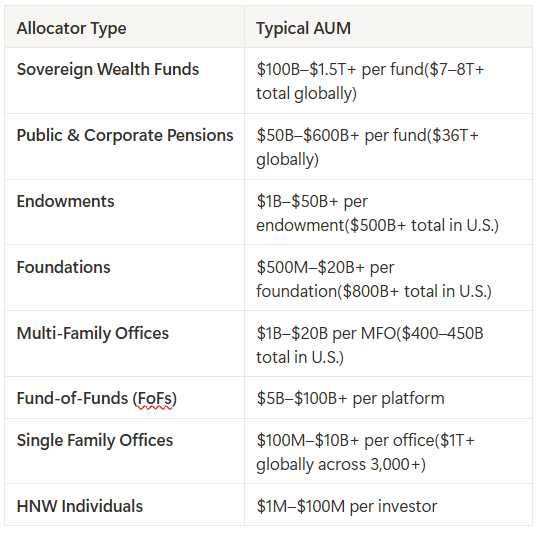
The analogy chosen is hyena pack. Like hyenas in the wild, allocators are highly social, opportunistic, and dependent on the success of predators. They rarely generate alpha themselves; instead, they compete fiercely to access the residual alpha left after hedge funds have fed.
Just as a hyena pack's strength is determined by its numbers2, an allocator's power is determined by its available capital. The strongest allocators—sovereign wealth funds and elite endowments—enjoy superior staffing, access to top-tier managers, better fee negotiations, and early entry into "hot" funds. Smaller family offices find themselves further back in the pecking order, left with fewer options and reduced bargaining power.
Structural Challenges for Small Scale Allocators
Now that we've established the alpha food chain and clearly identified where small-scale allocators such as single family offices are positioned, let's examine several structural headwinds they face. In short, small allocators face a world where more capital is chasing fewer mispricings, making it harder to find persistent alpha and even harder to access it on attractive terms.
1. Shrinking Supply of Alpha in Traditional Markets:
Over the decades, the overall supply of alpha has arguably been in decline in traditional markets. Several major forces include:
Market volatility may have structurally declined post GFC, reducing certain alpha opportunities. Extraordinary central bank policies in the 2010s (QE and low rates) dampened volatility and boosted all assets in tandem, reducing alpha opportunities for all hedge fund strategies.
The rise of passive investing and shrinking retail investors’ share of trading volume have reduced equity market inefficiencies and narrowed the alpha opportunity set in equities.
Even non-equity markets have become more informationally efficient with technology. Any pricing anomaly is now quickly arbitraged by automated traders. For example, in bond and FX markets, increased cross-border capital flow, information transparency and electronic trading have made life much harder for discretionary macro traders compared to the wild 1980s or 90s.
2. Intensifying Competition for Alpha (Too Many Predators):
Competition for alpha is a zero-sum game, one hedge fund gains at another’s expense. The more hedge funds there are chasing after the same pool of alpha, the less prey each will expect to catch. The number of hedge funds and amount of capital chasing alpha have skyrocketed since 1980s.
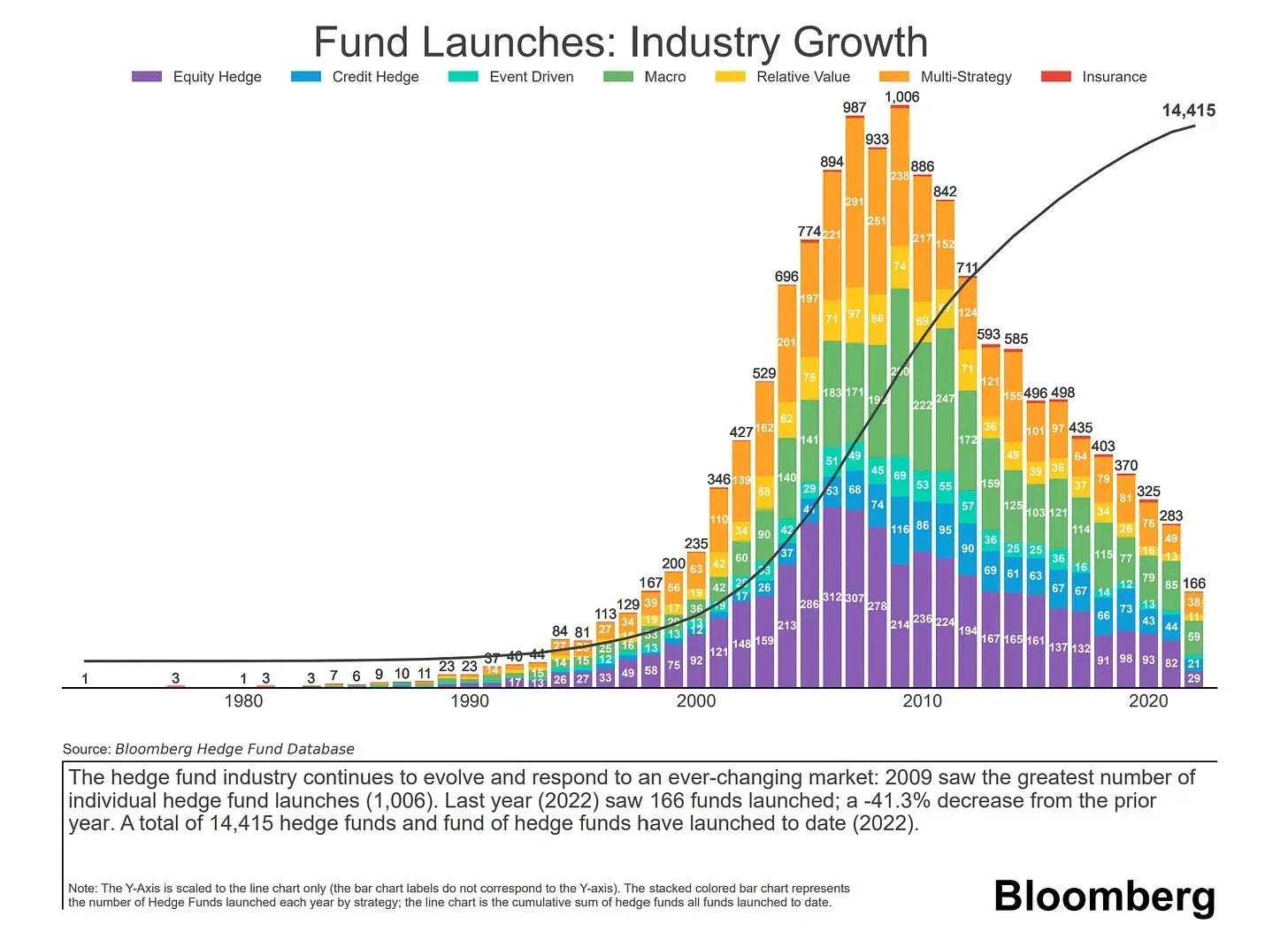
The hedge fund industry has grown from a few hundred funds in the 1970s/80s to approximately 14,000+ funds today. Assets under management have grown dramatically—roughly 17-fold from ~$300 billion in 1997 to ~$5 trillion in 2023 [Source]. As we have discussed above, market mispricing has decreased as markets have become more efficient during this period. The combined effect of shrinking alpha pie and more pros trading against each other, is that only brokers and the very best hedge funds will be consistent winners.
3. The Rise of Multi-Strat Giants:
Perhaps the most significant structural change in the hedge fund industry – and a challenge for both independent hedge funds and allocators – is the rise of Multi-Strats. They aggregate a lot of the industry’s talent under one roof, capturing alpha internally that external allocators would in the past try to access by investing in individual funds.
This development shrinks the pool of independent hedge funds available to allocators, especially in certain strategies like equities and macro. Fewer hedge fund startups in recent years (as evidenced by the Bloomberg chart above) means fewer fresh opportunities for allocators on the outside.
4. Higher Fees and Less Bargaining Power:
As mentioned earlier, smaller allocators generally pay higher fees to access hedge fund talent. Large pensions or SWFs often negotiate bespoke fee terms (e.g. no management fee, only performance fee over a hurdle, or 1 and 10 fees for big tickets). A single family office putting $5 million into a fund has virtually no negotiating leverage – they’ll pay full price (maybe even higher if it’s a commingled feeder fund with additional fees). Research has shown that institutions on average pay ~1%/15% while smaller allocators pay ~1.5%/20%, and many top managers simply won’t budge on fees for smaller tickets [Source].
5. Due Diligence Challenge:
Allocating to hedge funds requires significant due diligence on both investment and operational aspects. Large institutions have teams of analysts to source and vet funds, attend on-site meetings, negotiate side letters, monitor risk, etc. A small family office has limited resources and might not be able to thoroughly vet more than a handful of funds. This can put them at a disadvantage in identifying the truly good managers or avoiding the fraud landmines.
Additionally, big allocators often get better transparency or risk reporting from managers (increasingly more allocators doing SMAs). Smaller ones typically can only invest in commingled vehicles and may have to accept less information. This asymmetry means small allocators often must rely on intermediaries (more fees!) or trust managers more (which is not always ideal).
Despite these challenges, not all hope is lost. The very fact that giant funds and allocaters dominate and move slowly can create niches and nooks in the markets where smaller, more agile players can find refuge. It calls for a kind of “guerilla warfare” approach – using speed, creativity, and niche tactics to capture alpha in ways the big players either cannot or will not.
Guerrilla Warfare as a Winning Strategy
In military terms, a small force cannot win by directly confronting a giant head-on in open battle. Instead, it must exploit difficult terrain, agility, surprise, and specialization. Similarly, a small allocator can’t outbid a sovereign fund for access to a top-tier hedge fund, nor out-research a 100-person institutional team. But what they can do is: target opportunities that are too small or offbeat for big players, move quicker and with more flexibility, and align with unconventional talents that values independence over scale. Here are some ways small-scale allocators compete asymmetrically:
1. Be Early to Emerging Alpha Opportunities:
Guerrilla warfare means taking calculated risks on new terrain where the big army hasn’t marched yet. The first ones to exploit a new inefficiency often enjoy first-mover advantage until the institutional capital moves in to reduce the inefficiency.
Often, when a new market or strategy emerges, large institutions are late to the party due to bureaucracy or caution. Small, entrepreneurial investors can move in early and reap outsized gains before the space gets crowded. Whether it was tech-centric hedge funds in the 1990s, quant funds in the early 2000s, or crypto funds in late 2010s, it’s typically been smaller, agile capital that seeds these areas.
Of course, being early has risks, as many emerging opportunity sets flame out. But a small allocator can make a diversified portfolio of small bets in new arenas, the equivalent of building an internal fund of funds. Large institutions cannot justify that approach easily, as they hate the optics of justifying to investment committee any investment that significantly underperforms, and their ticket sizes are so large that “experimenting” is hard.
2. Partner with “Square Peg” Talent:
Not every great investor wants to work at a mega-fund or can fit into the mold of a large institution. There are talented traders and portfolio managers who prefer independence, have idiosyncratic styles, or simply don’t thrive under the constraints of a multi-strat platform. These are the “square pegs” who won’t slot into the round holes of big-firm risk frameworks or politics. Small family offices and small funds-of-funds can incubate or seed such managers, providing initial capital and support in exchange for a share of the economics or favorable terms.
3. Pursue Hard-to-Scale, Capacity-Constrained Alpha Pockets
There are strategies that do generate alpha but can’t accept billions of dollars. Big institutions often ignore these because they can’t deploy enough capital to make it worth their while or the strategies don’t fit their rigid mandates. This leaves fertile ground for smaller allocators.
Examples include: micro-cap or small-cap equity long/short, where the inefficiencies are plentiful but liquidity is low; niche trade finance strategies that are too small for a large fund; specialist funds in niche sectors such as shipping; other quirky strategies like life settlement.
Successfully implementing these strategies requires small-scale allocators to up their game through differentiated sourcing, continuous learning, scientific frameworks, and continuous improvement. This also demands organizations that employ them to foster a learning culture with incentive structures encouraging prudent risk-taking—though that's a topic for another day.
As a single-family office allocator, this question is never far from my mind: how can we, with limited scale and resources, carve out a durable edge in a game dominated by giants? That question drives this Substack and my ongoing search for overlooked alpha.
Through this forum, I also hope to connect with like-minded allocators and create contents that help each other. By forming a community, sharing ideas, pooling resources, and working together, we can put up a formidable fight in this competitive landscape.
What’s Next?
The crypto market neutral hedge fund space is fast-evolving and, in my view, still offers alpha density that rivals or exceeds traditional markets. While institutional capital has tiptoed in, inefficiencies remain, especially in cross-exchange arbitrage, funding spreads, on-chain data exploitation, and increasingly arbitrage between crypto and traditional assets. In the next several posts, I’ll dive into this frontier: where the opportunities lie, who the players are, and how small-scale allocators might gain a foothold before the edge gets fully arbed away.
Stay tuned.
I recently read Flash Boys by Michael Lewis, which offers a compelling narrative on the rise of high-frequency trading (HFT) in U.S. equity markets. It provides valuable context on how HFT firms exploit speed, order flow, and market microstructure—insights that remain relevant to understanding today’s liquidity provision strategies.
This video showing how a large pack of hyenas can challenge a lion.