
My Lessons from a Near-Miss with Point Bonita
“It ain’t what you don’t know that gets you into trouble. It’s what you know for sure that just ain’t so.”

Point Bonita (hitherto called PB) is a trade-finance hedge fund that’s been in the news lately. The strategy sounds disarmingly simple: buy short-dated, bilateral receivables at a small discount and collect at maturity. If counterparties pay as agreed, you clip a steady, largely uncorrelated return. The opportunity exists because traditional banks have pulled back from this niche—Basel III made financing trade receivables more capital-intensive.
Point Bonita has been on my radar for over a year. What’s not to like when the five-year return line looks like a ruler? That near-straight line is the holy grail for uncorrelated hedge funds—no surprise that marquee allocators (e.g., GIC and other top SWFs) reportedly backed it.
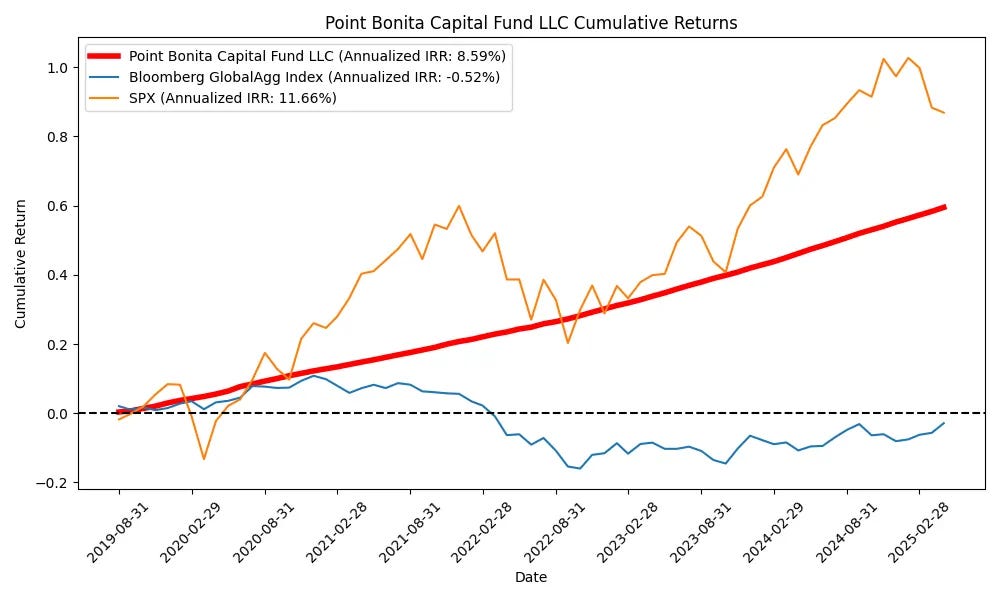
Still, “too good to be true” rang in my head. I spent a year tracking the fund, looking for the catch, but I didn’t find one. So, when the First Brands situation surfaced and the impact on Point Bonita became clear, I was close to finishing a 30-page IC memo. Had the event hit a few weeks later, I’d have been caught in the storm.
As widely reported, PB had roughly a quarter of its assets linked to First Brands—much higher than the top concentration it communicated (150+ obligors, largest single exposure ~12% from a BBB+ mining company). What did I miss? I went back through the DD materials. Not a single mention of First Brands. Why?
My conclusion: PB didn’t omit First Brands to deceive investors. They assumed it wasn’t material to highlight—because, in their view, the receivables were legally ring-fenced and thus insulated from First Brands’ balance sheet. To see why that assumption felt reasonable (until it didn’t), we need to walk through how trade finance works.
How Trade Finance Works
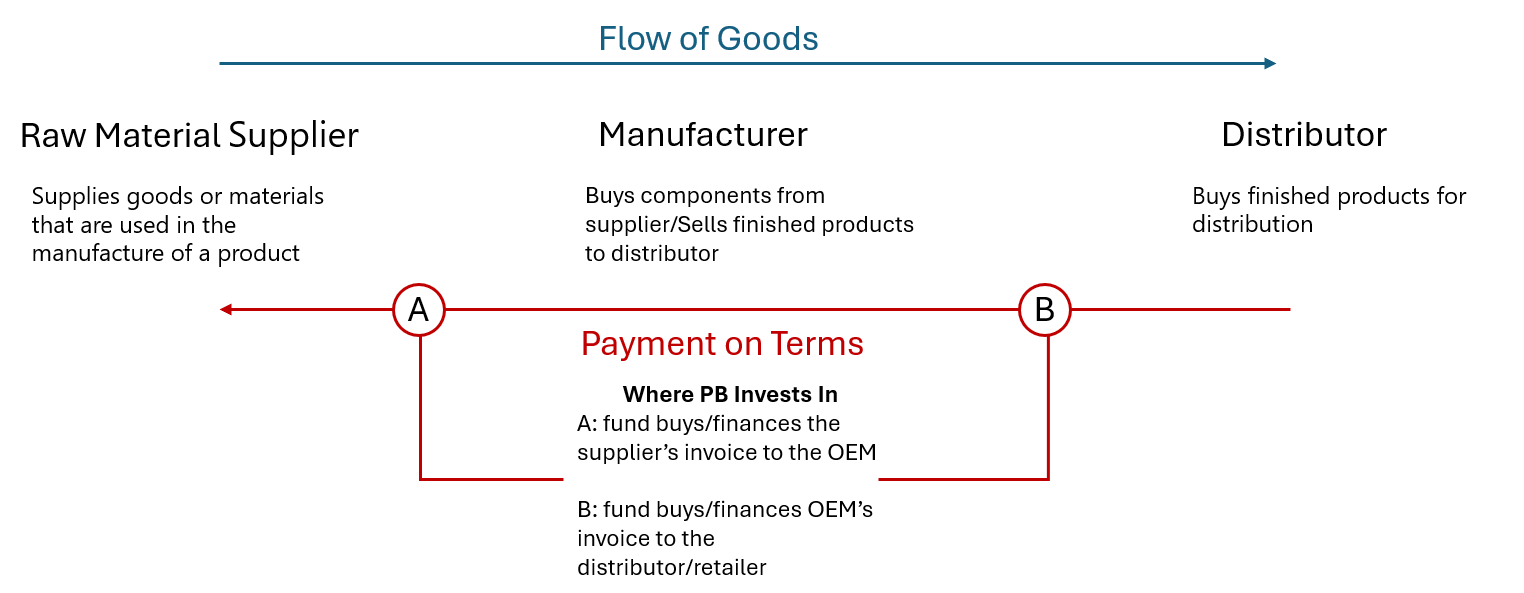
In this diagram, goods move left → right through a chain: Supplier → OEM/Manufacturer → Distributor/Retailer. Cash moves right ← left on terms: buyers pay later (30–90 days).
This delay creates funding gaps. Trade-finance funds step in by buying or lending against approved invoices:
Point A: finance the receivable from a supplier to the OEM.
Point B: finance the receivable from the OEM to the distributor/retailer.
In both cases, the fund advances cash soon after shipment and is repaid by the buyer at invoice maturity. Short duration. Self-liquidating. Tied to real goods.
That’s the clean theory. In practice, it’s operationally messy. Which is why a receivables aggregator often sits in the middle.
Receivables Aggregator: Convenience with a Catch
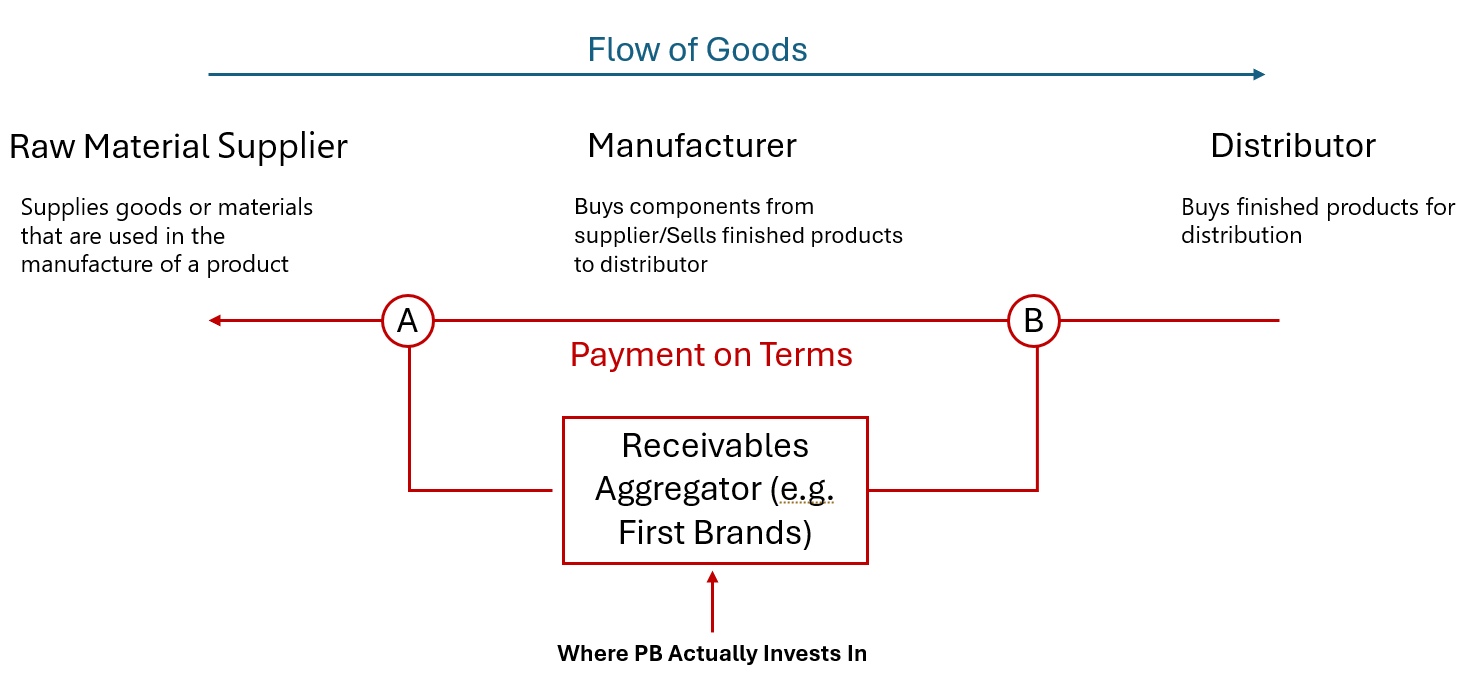
First Brands stood between PB and many small suppliers, aggregating receivables, handling invoice validation, buyer confirmations, payment flows, and reporting. For PB, this was efficient and scalable: fund one structured facility instead of onboarding hundreds of tiny vendors. It concentrates operations and simplifies risk. It also streamlines KYC/AML and accounting, and lets PB hold standardized, short-dated assets tied to large, creditworthy buyers.
PB wasn’t blind to counterparty risk. They structured purchases as true sales, aiming to keep the receivables bankruptcy-remote from First Brands. Under normal stress—missed payments, insolvency—this kind of ring-fencing often works: the invoices and their cash flows should sit outside the aggregator’s estate.
PB’s error wasn’t ignorance of risk; it was mis-scoping the risk. The structures guarded well against insolvency—but not against dishonesty.
What Actually Went Wrong
The protection only works if the assets are real, unique, and unencumbered. Allegedly, First Brands over-pledged the same receivables to multiple financiers, creating duplicate claims on the same cash flows. Once that’s true, ring-fencing becomes a priority dispute—not a shield. Instead of clean, self-liquidating paper, PB faced arguments over who owned what, whether notice of assignment and control over collections were airtight, and whether any interests were perfected first.
In short: PB protected itself from counterparty failure, but not from asset-integrity failure.
My Lessons Learnt
Follow the money end-to-end. Map the actual flow of funds and the exact collection account controls (lockbox/DACA), not just the legal labels.
Name every counterparty that touches cash. If you can’t point to them on a diagram, you haven’t found all the risk.
Interrogate concentration—economically, not just legally. “150+ obligors” matters less if a single program or servicer intermediates a quarter of the capital.
Underwrite asset integrity, not only credit. True sale, perfection, notice, and control are necessary—but also verify uniqueness: obligor confirms, audit trails, anti-double-pledge tech, and purpose-built crime/fraud coverage (trade-credit insurance often excludes seller fraud).
Assume success creates its own tail risk. Prior to blowup, First Brands had not missed a single payment to PB in past six years, it bred comfort and silenced questions. Long runs of smooth performance can mask build-ups of hidden leverage or duplicate pledges.
Bottom line: I still like the concept of short-dated, self-liquidating receivables. But next time, I’ll demand complete visibility from invoice to cash, explicit disclosure of any aggregator-level concentrations, and hard evidence that the assets I’m buying are the only claims on those cash flows.