
[Update] Millennium GP Stake Analysis - Through Allocator’s Lenses
Beauty is in the eye of the beholder

[12 Aug 2025] Update: New information on the MLP GP stake deal shows that a key fact in my earlier article was incorrect: GP’s 20% carry is charged on fund-level net return, not fund-level gross return, as illustrated below:
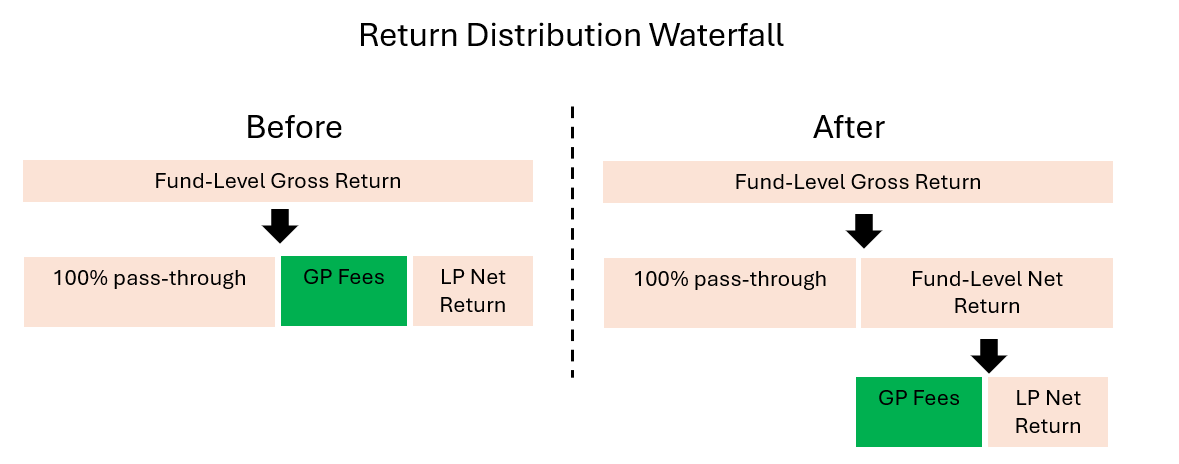
This correction significantly reduces the base-case cash yield from 16% to about 8%, and reduces expected 5-year total IRR from 22.3% to 14.4%.
This post has been updated accordingly. Apologies for the earlier errors.
Millennium's recent decision to sell a minority stake at a reported $14 billion valuation (18.7% of AUM) marks a rare strategic shift for one of hedge fund industry's most closely held firms1. While speculation abounds about Izzy Englander's motivations, my aim here is to analyze this investment opportunity strictly through an allocator's lens.
The appeal of this deal is nuanced. Its value depends heavily on the allocator’s size, liquidity tolerance, and return target. Here's the breakdown.
What GP Stake Investors Are Buying
A stake in Millennium’s management company means owning 10–15% of the firm that runs the fund: setting strategy, allocating capital, managing risk, and running operations.
Unlike LPs, GP stakeholders earn from the management company’s fee revenue:
<=4% Fund-Level Net Return: 1% management fee on total fee-paying AUM, regardless of performance.
>4% Fund-Level Net Return: 20% performance fee kicks in instead.
Because Millennium passes 100% of expenses to LPs, this revenue is effectively high-margin. That makes a GP stake an equity-like slice of a fee machine, directly tied to AUM and performance.
The transaction likely will involve a stake sale totaling USD 1B:
USD 150M reserved for MLP senior management
USD 100M for GS employees
USD 750M offered to Goldman Sachs Global Private Wealth clients
GP Stake vs. LP Investment
From an allocator’s perspective, a GP stake isn’t just a beefed-up LP position—it’s a fundamentally different exposure.
Think of it like owning a cash-generating business vs. holding a fund interest diluted by fees. The GP stake delivers returns via:
Net cash yield (i.e., dividends after Goldman’s overlay fees and taxes)
Capital appreciation (as AUM and fee income grow)
Let’s examine both components.
Expected Net Cash Yield: Base Case 8%, Bear Case 3.5%
Using currently available information2, we can clearly illustrate the net yield profile for a non-US GP stake investor3 as compared to fund LP:
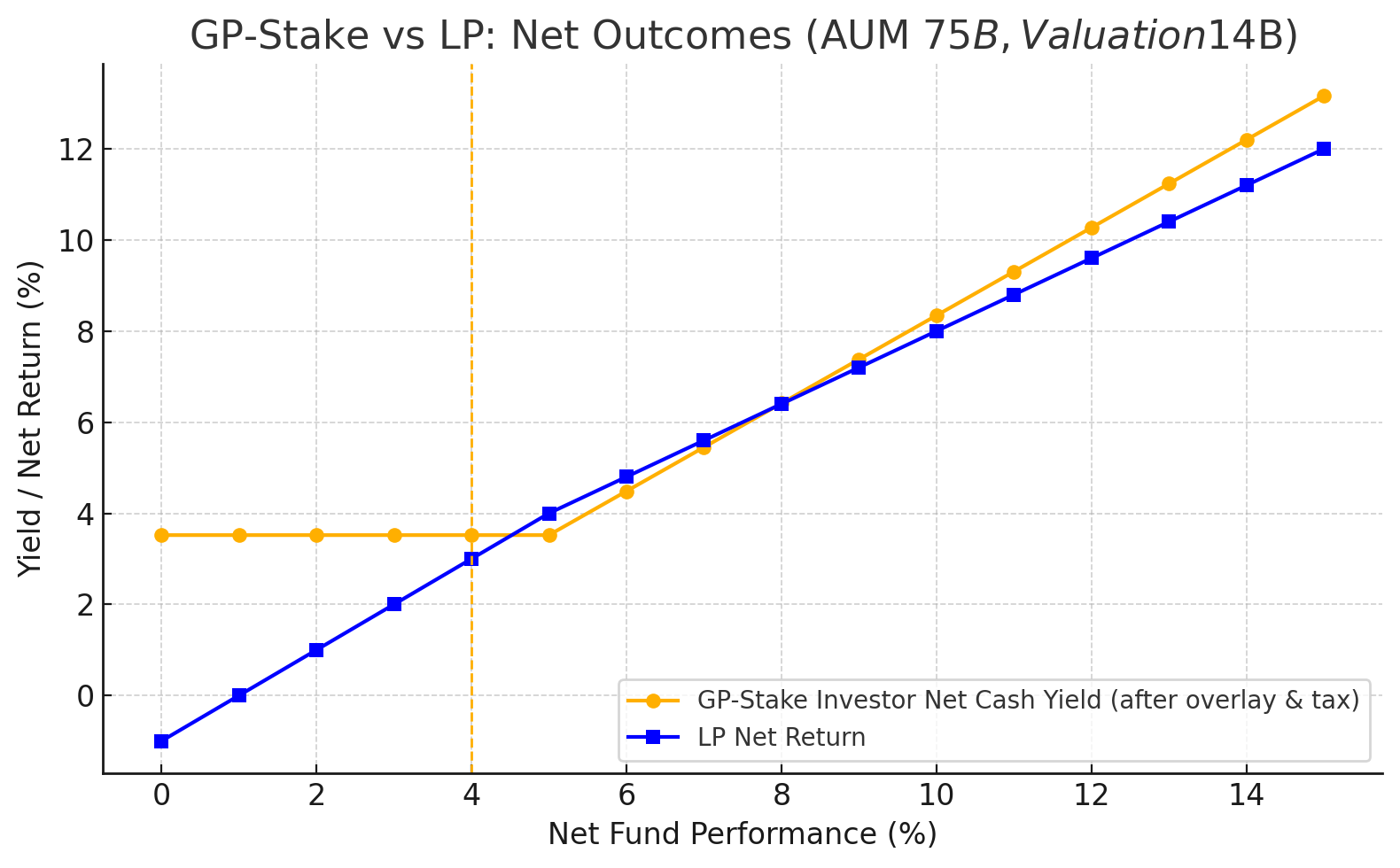
Two takeaways:
it highlights the inherently superior return profile of a GP stake relative to a direct LP investment. The GP stake behaves like a bond with equity upside: steady yield in down years, amplified upside in good years.
we can leverage this chart to estimate forward-looking returns for GP stake investors. Millennium’s International Fund has delivered a LP net return of approximately 12.5% annually over the past five years, implying a historical fund net return around 16% and a corresponding GP stake net yield of roughly 13%, a fantastic level of performance likely to be heading lower in future.
Scenarios for Expected Return:
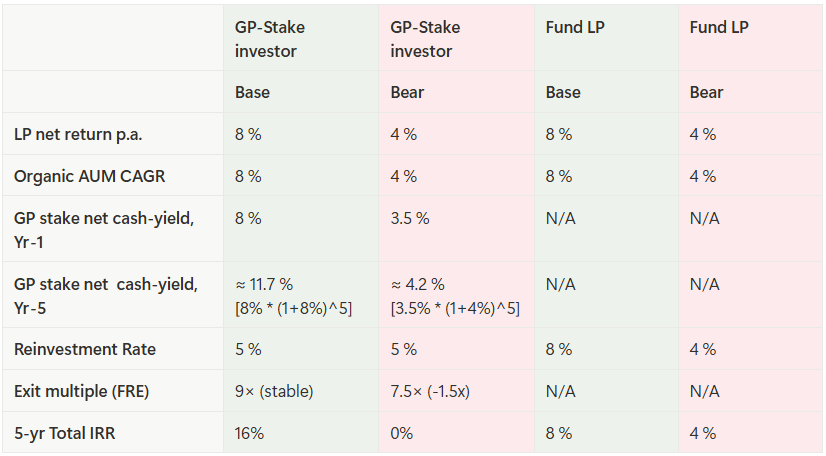
Base Case: Considering Millennium’s larger asset base (+50% since 2020) and intensifying talent war among Multi-Strats, it is reasonable to assume a lower fund-level net return of 10% p.a. over the next five years, as Millennium itself is projecting ~10% fund-level net return for full year 20254. This implies GP stake net cash yield in the 8% range.
Bear Case: we can take this year as a reference point. The implementation of Trump's tariff policies led to sharp equity volatility spikes and sharp reversals, causing systematic de-grossing across Multi-Strategy funds with equity-focused portfolios. Consequently, Millennium's first half LP net return stands at only 1.7%. Assuming full year LP net return of 4%, this translates to floor net cash yield of 3.5% for GP stake investors.
Capital Appreciation Potential
The capital appreciation is driven by the combined effects of net cash yield growth (akin to earnings growth for stocks) and changes in valuation multiples.
Expected Net Cash Yield Growth Rate: Base Case 8% p.a., Bear Case 4% p.a.
The growth rate of net cash yield is directly linked to Millennium’s AUM growth, because of Millennium’s fee scheme and 100% cost passthrough. The critical question therefore becomes whether the AUM growth of Multi-Strats, like Millennium, is cyclical or structural in nature.
Millennium’s AUM has grown steadily from USD 7 billion in 2009 to USD 75 billion today:
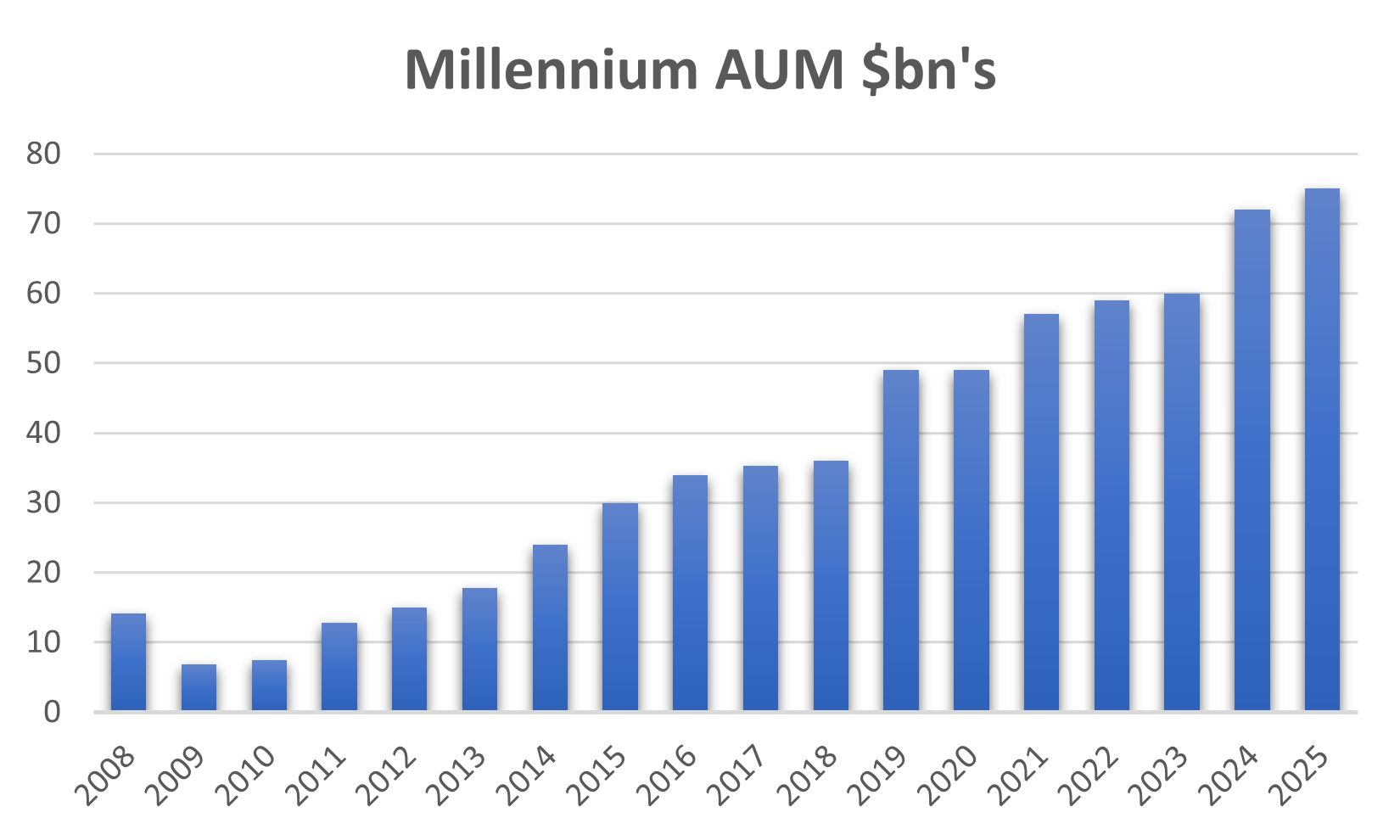
Source: Rupak Ghose
Meanwhile, total AUM managed by multi-strategy hedge funds overall has quadrupled over the same period:
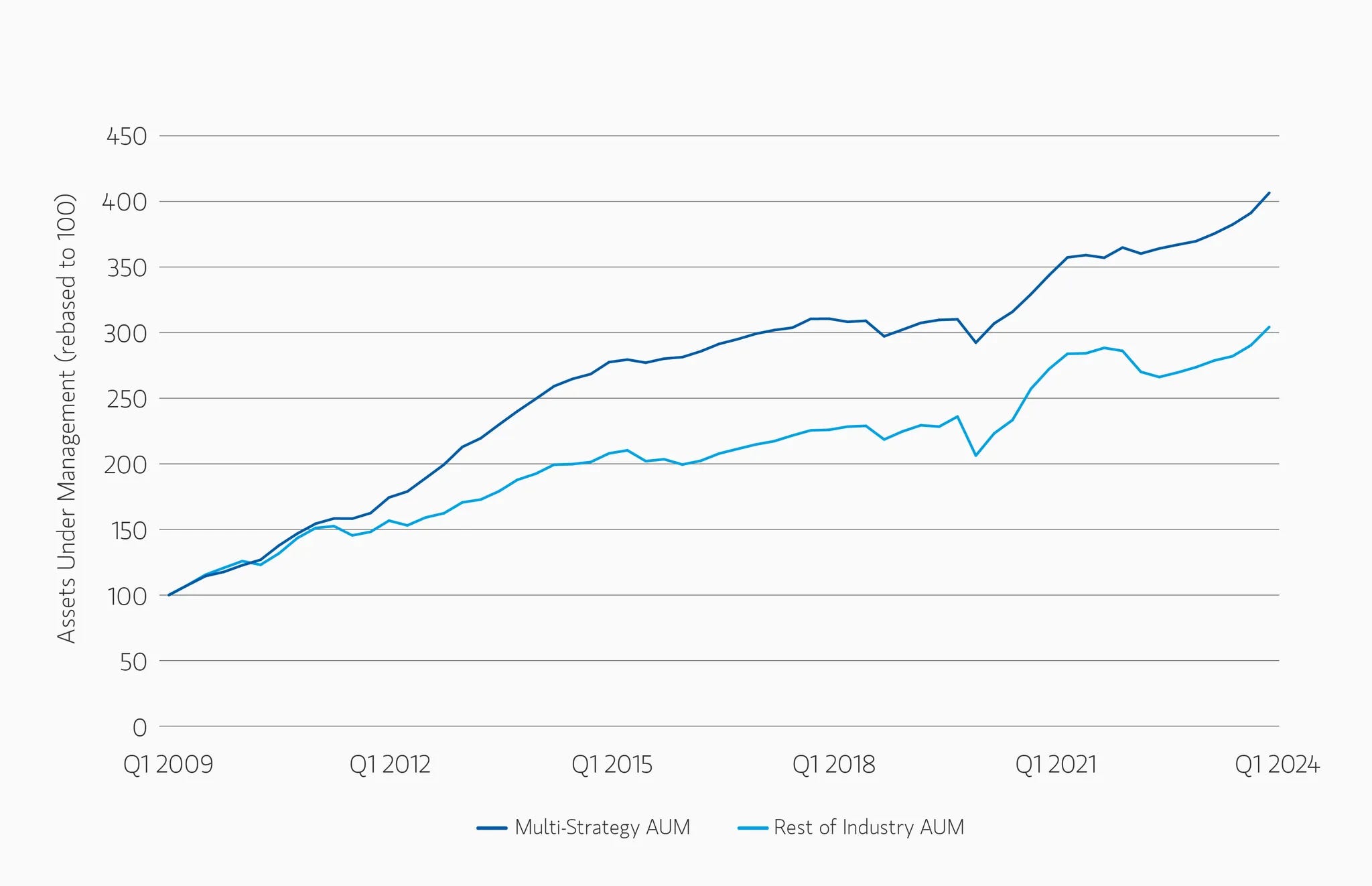
Source: Morgan Stanley
In my view, Multi-Strats’ growth is predominantly driven by structural forces. To understand why, it’s helpful to briefly revisit the history of multi-manager hedge funds. The evolution from A.W. Jones’s pioneering multi-manager hedge fund in 1949 to the multi-strategy giants of today, such as Millennium (founded in 1989) and Citadel (1990), reveals a long-term shift toward larger, institutionalized platforms.
For readers interested in learning more about the evolution of the hedge fund industry, I recommend the book "More Money Than God"
The fundamental competitive advantage these firms possess is their ability to separate distinct skills that are usually bundled together in traditional hedge funds. Specifically, generating investment ideas (alpha), implementing these ideas through effective execution, and running a hedge fund as a business represent entirely different skill sets. Multi-Strategy platforms specialize in implementing alpha efficiently at scale while institutionalizing risk management, thereby freeing talented investment managers from the burden of operational responsibilities.
Scale itself becomes a crucial moat. With a 100% pass-through expense structure, larger funds like Millennium can invest heavily in top talent, best-in-class infrastructure, data, and execution capabilities, thereby reducing costs per dollar of alpha generated. These advantages become self-reinforcing, as bigger funds continually attract more talent and capital—creating a "Winner Takes All" dynamic. Consequently, both my base and bear cases assume no meaningful client redemptions over the next 5 years.
I also don't expect Millennium to raise significant fresh capital during this period. The firm hasn't been actively fundraising in recent years. In March 2025, it launched a new vehicle with a drawdown structure, but to date, only $3B of the $10B capacity has been drawn down.
Putting it all together, my base case for Millennium's five-year AUM trajectory is purely organic growth at the net returns rate of 8%, with a bear case of 4%. These projections assume Millennium neither distributes capital nor faces redemptions.
Exit Valuation Multiples: Base Case 9x , Bear Case 7.5x
Valuation multiple has been extensively analyzed by industry expert Rupak Ghose here. Informed by his insights, my valuation assumptions are as follows:
Under the base scenario, where Millennium maintains steady high single digit net returns, its valuation multiple would likely remain stable at approximately 9x.
In a bear scenario, adverse market conditions or regulatory tightening could compress Millennium’s valuation multiple from today’s level of approximately 9x earnings down to around 7.5x (comparable to Citadel’s GP stake multiple in 2022).
Putting It All Together
Below is a fully integrated five-year outlook that contrasts a GP-stake investment with a direct LP position under the base and bear scenarios5:
Now let’s assign probabilities for the two scenarios. As shown below, in the past 12 years, Millennium's LP net returns fell below 8% for only 3 years from 2016-18 (a base probability rate of 25%).
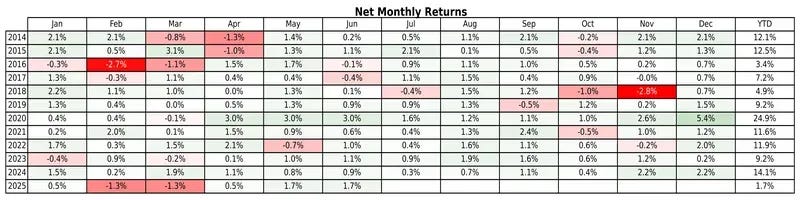
Source: Hedge Fund Database
However, these underperforming years occurred during a low-volatility market environment caused by ultra-loose monetary policy—generally unfavorable conditions for uncorrelated strategies. Since then, markets have entered a new phase of heightened volatility, likely to persist given rising global geopolitical uncertainties and Trump's policy shocks.
Based on these factors, I assign just 10% probability to the Bear case and 90% to the Base case, resulting in a final expected 5-yr IRR of approximately 14.4% for GP stake investors, compared to 7.6% for Fund LPs.
Risk Profile
Having covered the return potential, let’s now assess the key risks involved with investing in Millennium’s GP stake.
Illiquidity Risk: High
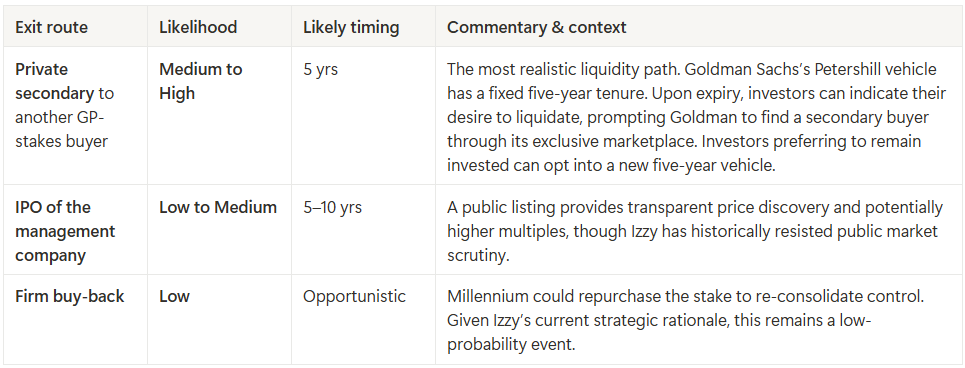
While 96% of Millennium’s Fund LP investors are under the five-year lock-up share class (with a 5% quarterly redemption gate), the GP-stake investor faces potentially perpetual illiquidity. Nonetheless, there are several plausible exit avenues:
Leverage Risk: High
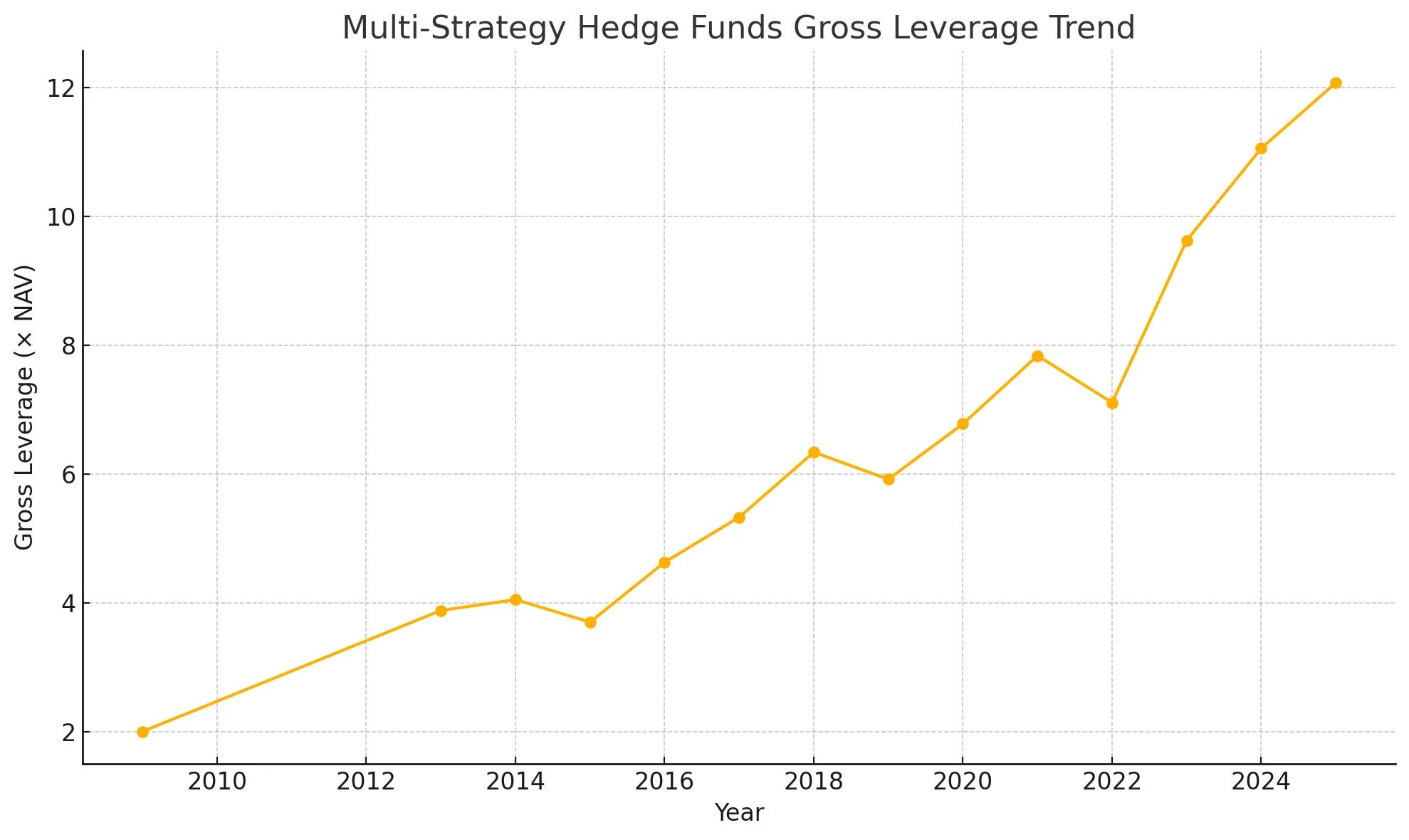
The use of leverage by Millennium and other multi-strategy funds has been steadily increasing since the Global Financial Crisis:
Data Sources:
2009 Estimate: Academic estimate from Khandani & Lo’s (2011) study of post-crisis deleveraging.
2013–2025 Data: U.S. SEC Form PF filings, aggregated by the Office of Financial Research’s "Hedge Fund Monitor."
This escalating leverage presents the most concerning risk in this analysis. It implies multi-strategy trades may be approaching consensus and crowding levels, significantly increasing the left-tail risk. Specifically, there's an elevated danger of systemic de-grossing across multi-strategy funds occurring simultaneously—triggering potential cascading liquidations reminiscent of past financial crises.
Yet, two practical reasons explain why this elevated leverage risk is unlikely to deter large institutional investors:
Left-tail risk is inherently difficult to quantify and model accurately. Its severity and probability often become fully visible only after adverse events occur. Institutional investors typically acknowledge but implicitly accept this uncertainty in pursuit of consistent returns.
Career risk often outweighs performance risk in institutional decision-making. As Keynes famously noted, "It is better to fail conventionally than succeed unconventionally." Millennium is widely recognized as a consensus leader in the consensus-oriented multi-strategy segment. For institutional allocators, passing on a prestigious GP stake opportunity in Millennium would carry significant reputational and career risk.
Minority Shareholder (Key-man) Risk: Low
Minority GP-stake investors face the inherent risk of Izzy Englander’s eventual departure, given his central role as founder and figurehead holding together Millennium’s expansive empire. There is uncertainty regarding how smoothly control will transition from the founder to a professional management team.
Mitigating factors include:
Aligned Interests Among Stakeholders: All three groups of GP-stake investors will invest through the same Goldman Sachs-managed vehicle. Izzy has strong incentives to protect the senior management team's interests, inherently aligning other minority stakeholders' interests with theirs.
Deepening Talent Bench: Over recent years, Izzy has systematically enhanced Millennium’s management ranks with experienced, institutional-quality talent. Notable hires from top-tier institutions like Goldman Sachs and other competitors indicate deliberate succession planning (as widely reported in the Financial Times and other industry sources).
Structural Resilience of Multi-strategy Platforms: Multi-strategy hedge funds have earned the nickname "alpha factories" for their robust operating structures, which reliably generate returns regardless of a single individual's presence. Even if Izzy were to depart unexpectedly, Millennium’s institutionalized model—built around multiple autonomous teams, rigorous risk management, and deep operating infrastructure—would likely sustain strong performance during a management transition period.
Taken together, these mitigating factors significantly reduce the potential negative impact of the key-man risk associated with Izzy Englander’s eventual transition out of leadership.
Conclusion: Scale Matters
The GP stake makes strategic sense for large institutional allocators with long horizons and tolerance for illiquidity. With a projected 14.4% IRR, strong margins, and deep moat, this is a premium asset.
For smaller allocators, however, the high illiquidity, leverage sensitivity, and lack of diversification make the case weaker. In many cases, top-tier PE buyouts offer better risk-adjusted returns.
Bottom line: This is a strong opportunity—but only for the right type of investor.
Key inputs used to model net return profile for GP stake:
Fee structure as described beforehand
As of this writing, the total fee-paying AUM is 75B.
100% of management company’s operating expenses (PM comp, tech, etc.) are passed through to LPs
Non-US investor’s fee and tax adjustments:
Goldman Petershill overlay: 1% annual management fee (on stake cost)
Performance fee: 10% of post-management-fee gain
Tax drag: 0.4% annual deduction
Net return for LPs = fund-level net return - GP fee ratio
Main difference between US and non-US investors is tax shrinkage: estimated 2.5% p.a. for US investors and 0.4% for non-US investors.
For 2025, Millennium Management Company is projecting a USD 1.59B profit before tax. This translates to approximately 2.1% of their current USD 75B AUM, corresponding to ~10% fund-level net return (calculated as 2.1% divided by the 20% performance fee), and 8% LP net return.
Additional note to bear-case assumption: Exit valuation is anchored to a normalized 8% p.a. LP net return, not the 4% realized during the period. We assume a temporary five-year underperformance, not a permanent deterioration in MLP’s franchise.
Thanks for the work !!!